5 months ago
70
5 months ago
70
The post The Best Mortgage Comparison Sites to Use When Buying a Home appeared first on Penny Pinchin' Mom.
Buying a home is an exciting but intimidating endeavor. There are a lot of choices involved — the location of the home, the number of bedrooms and bathrooms, the architectural style, the square footage, and so on. But the most important decisions you’ll make in the homebuying process are financial, with the lender playing a significant role.
What’s easy to forget is that your choice of lender can mean the difference of tens of thousands of dollars over the life of your loan. Rates, fees, and closing costs vary significantly from lender to lender, and a borrower who doesn’t shop around may never know they’re overpaying.
The good news is that you don’t have to walk into a bank and simply take whatever they offer. Mortgage comparison sites let you survey dozens of lenders at once, so you can arrive at any conversation already knowing what a competitive offer looks like.
With that in mind, here’s a look at some of the best mortgage comparison sites that can help to narrow down your lending options.
At a Glance
| Best For | Pros | Cons | |
| BestMoney | Quick research and usability | Great for quick researchScores and reviews for each lenderHome affordability calculator | No VA or FHA loan filtersDoesn’t show rates on its siteNo user reviews |
| FindMortgages.com | Beginning the mortgage search | Focuses entirely on mortgagesHas a VA loan filterScores and reviews for each lender | Limited number of lendersNo user reviewsNo mortgage calculators |
| Bankrate | Comparing interest rates and APRs | Presents interest rates and APRs on its siteHas VA and FHA loan filtersMortgage calculators | Potentially overwhelming number of lendersSome mortgage lenders are unratedNo side-by-side comparison |
| NerdWallet | Mortgage education | Presents interest rates and APRs on its sitePlenty of mortgage calculatorsHas VA and FHA loan filters | No user reviewsNo side-by-side comparisonPotentially confusing rating system |
| WalletHub | User reviews | Presents interest rates and APRs on its siteUser reviewsSide-by-side comparison | No VA or FHA loan filtersNo editorial reviewsNo detailed articles on mortgages |
BestMoney: Best for Quick Research and Usability
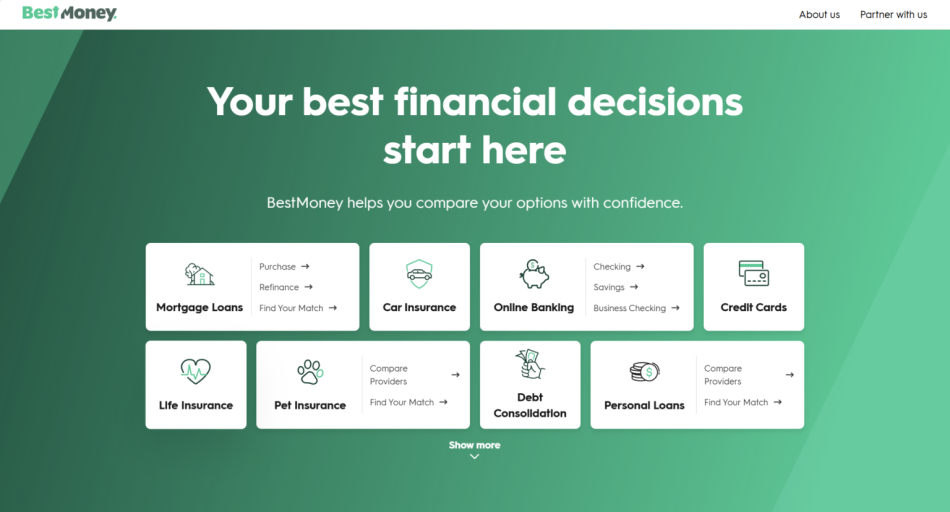
BestMoney is all about financial decision-making; they help you compare your options across a variety of products, from insurance to banking to loans. Aside from their comparison features, BestMoney also has an article library addressing common personal finance topics.
Lender Coverage and Filters
BestMoney’s mortgage comparison tool has several filters you can use to find the best lending options for your situation. First, you’ll select whether you’re purchasing a home, refinancing an existing mortgage, or seeking a home equity loan. Then, you’ll filter based on your credit score and loan amount.
While BestMoney doesn’t have the most extensive list of lenders, they still give you plenty of choices. For example, when I used the default filter selections (purchasing, good credit score, up to $100K loan amount), it showed me eight lenders. This is a good middle ground, providing several options to explore while not overwhelming you.
Also, while some comparison sites show you the current lending rates outright, BestMoney doesn’t. Instead, there’s a “View Rates” button next to each option, directing you to an online form on the lender’s site.
Ratings and Reviews
BestMoney focuses solely on editorial, rather than user, reviews. They assign each mortgage lender a score out of 10 possible points, focusing particularly on social proof and brand reputation.
To learn more about a specific lender, you can navigate to BestMoney’s Reviews section, which currently contains detailed write-ups on ten lenders, covering factors like loan features, the application process, and repayment terms.
Financial Education
Beyond being a straight comparison tool, BestMoney offers articles that cover the mortgage approval process, how refinancing works, and how to get a lower mortgage rate.
There’s also a home affordability calculator to give you an idea of how much you can realistically pay, the result of which is based on detailed inputs across income, loan information, and other costs like property taxes and homeowners’ insurance.
Pros
- Great for quick research
- Scores and reviews for each lender
- Home affordability calculator
Cons
- No VA or FHA loan filters
- Doesn’t show rates on its site
- No user reviews
FindMortgages.com: Best for Beginning the Mortgage Search
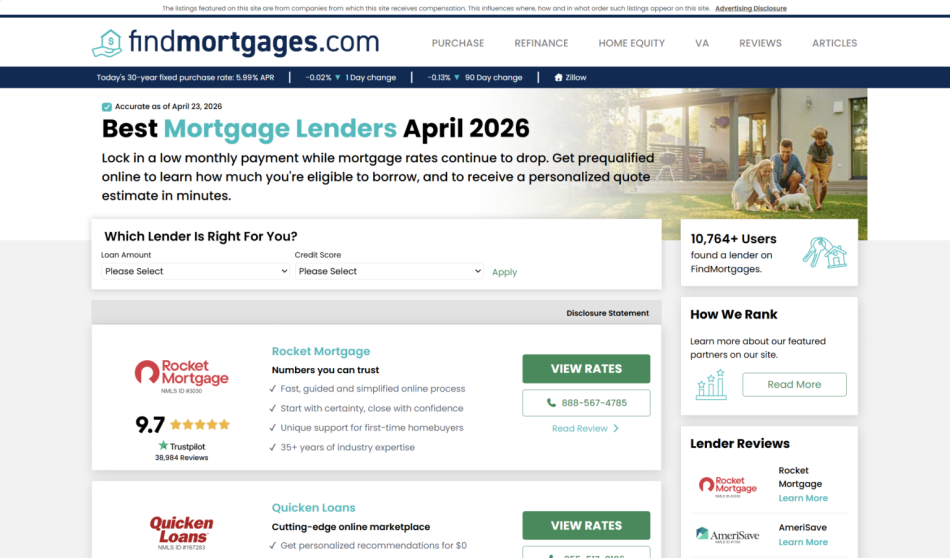
True to their name, FindMortgages revolves entirely around mortgages, keeping things streamlined, focused, and user-friendly.
Lender Coverage and Filters
FindMortgages has separate sections for purchasing, refinancing, home equity loans, and VA loans, and within each section, there are filters for the loan amount and your credit score. They don’t cover a large number of lenders, so perhaps not the best choice for extensive research.
Similar to BestMoney, in order to view a specific lender’s rates, you’ll have to click the “View Rates” button, which takes you to the lender’s site.
Ratings and Reviews
FindMortgages scores each mortgage lender a score out of 10, considering their TrustPilot TrustScore and variables like loan features, interest rates, and brand reliability.
They also have a Reviews section, which currently contains editorial reviews of six lenders. These reviews discuss pros and cons, the loan types offered, and the application process. However, all reviews are developed by their editorial team — there’s no section for users to leave their own feedback.
Financial Education
Besides comparison features, FindMortgages has articles you can read through to learn more about mortgage lending, with topics including prequalification and preapproval, rate loan terms, home equity loans, and refinancing. However, they don’t have any interactive tools like calculators.
Pros
- Focuses entirely on mortgages
- Has a VA loan filter
- Scores and reviews for each lender
Cons
- Limited number of lenders
- No user reviews
- No mortgage calculators
Bankrate: Best for Comparing Interest Rates and APRs
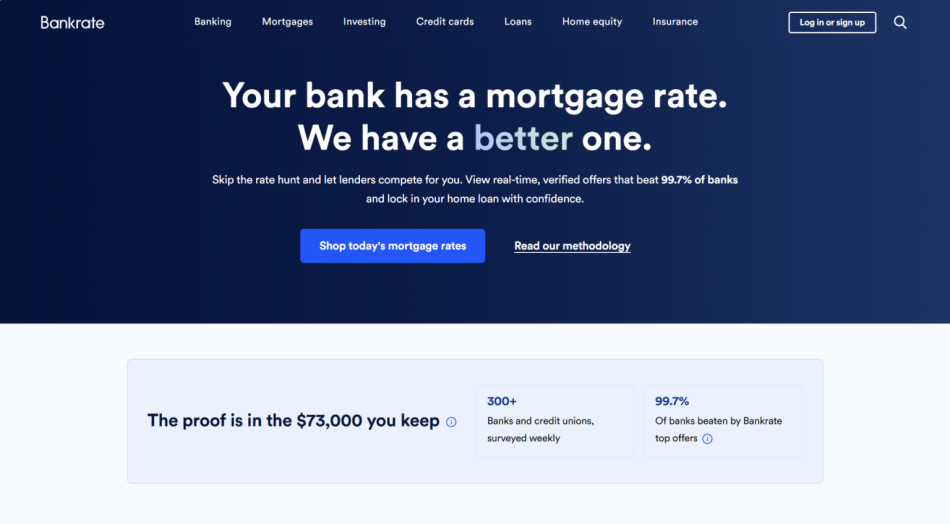
Mortgages are one of Bankrate’s specialties, though the comparison site can also help you in your search for bank accounts, investments, credit cards, and insurance.
Lender Coverage and Filters
Bankrate incorporates extensive filtering into the comparison process; once you’ve selected whether you’re purchasing or refinancing, you can filter based on ZIP code, purchase price, down payment, credit score, loan term, property type, debt-to-income ratio, points, and property use. You can also choose whether you want to view VA or FHA loans.
They have a fair amount of lenders to wade through, and you can sort the list based on what’s most important to you: interest rate, APR, monthly payment, or upfront costs. In fact, one of their main advantages is how they clearly present both interest rates and APRs, both of which are updated regularly. They also show average monthly payments.
Ratings and Reviews
Bankrate’s approach to mortgage reviews balances the editorial side with the consumer side. Their team assigns scores out of five stars, and there are comprehensive reviews of each lender’s affordability, availability, and the overall customer experience. In all, their mortgage lender reviews page displayed 66 lenders for my state.
Users can also input their own ratings and reviews, scoring each lender out of a maximum of five stars and rating them by professionalism, knowledge, responsiveness, and level of service. Many lenders have hundreds of reviews in total, though some smaller options are unrated.
Financial Education
Comparing rates is Bankrate’s bread and butter, but they also have calculators for mortgages and amortization. They also have a mortgage news page that keeps you up to date on current events and trends. Finally, they also present historical mortgage rates and show rate forecasts.
Pros
- Interest rates and APRs without clicking through to the lender
- VA and FHA loan filters
- Mortgage calculators
Cons
- Potentially overwhelming number of lenders
- Some mortgage lenders are unrated
- No side-by-side comparison
NerdWallet: Best for Mortgage Education
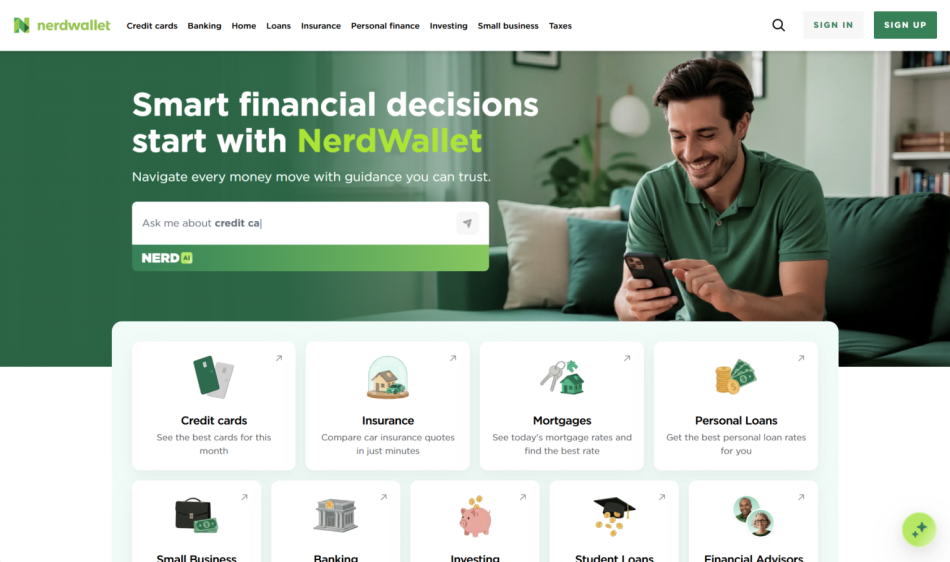
NerdWallet is one of the most popular personal finance sites, with extensive resources on credit cards, banking, mortgages, insurance, retirement, and taxes.
Lender Coverage and Filters
To compare mortgage rates on NerdWallet, you first need to choose whether you’re purchasing, refinancing, or searching for a home equity loan. Then, you can filter based on factors like your credit score, ZIP code, purchase price, down payment, or loan term. You can also select your property type and property use, as well as choose whether you want to view VA or FHA loans.
One of NerdWallet’s standout features is that it directly presents the rate information, including APRs and interest rates — there’s no following links to lender sites. It also displays estimated monthly payments and total fees, considering lender fees and lender credits.
That being said, NerdWallet doesn’t have the most thorough lender database. For purchasing, I used the default filters for my ZIP code, and it showed me five lenders.
Ratings and Reviews
NerdWallet rates and reviews lenders like Bank of America, PNC Bank, US Bank, and Chase. You will need to pay attention to what the rating is specifically for, though. Some of the scores are for home loans overall, while others are for specific loan types (HELOCs, jumbo loans). Their reviews discuss pros and cons, the customer experience, and the application process.
Just note that all of NerdWallet’s scores and reviews are editorial — there’s no place for users to publish their own thoughts.
Financial Education
While product comparisons are certainly a large part of what NerdWallet does, it’s better characterized as a broader personal finance site due to the utter plethora of educational resources. They have a mortgage news section, providing daily updates on rate changes. They even have a first-time homebuyer’s guide, containing FAQs, tips, and strategies.
The calculators are also extensive, with options for calculating mortgages, down payments, affordability, closing costs, cost of living, mortgage amortization, refinancing, and rent vs. buy situations.
Pros
- Interest rates and APRs are presented on-site
- Plenty of mortgage calculators
- VA and FHA loan filters
Cons
- No user reviews
- No side-by-side comparison
- Potentially confusing rating system
WalletHub: Best for Side-by-Side Comparisons

While many people think of WalletHub as a credit card comparison tool, their comparison features extend beyond cards. They cover numerous topics within the categories of credit cards, loans, and banking, making them a useful resource when searching for a mortgage lender.
Lender Coverage and Filters
WalletHub has plenty of mortgage lenders in their database; for my ZIP code, it showed me 58 options in total.
To wade through the list, the first thing you need to do is select whether you’re purchasing or refinancing. Next, you can filter by loan amount, down payment percentage, location, loan type (15-year fixed, 30-year fixed, 5/1 ARM, 7/1 ARM), and institution type. Beyond filtering, you can sort the list based on interest rate, fees, APR, loan type, and monthly payment.
For each lender, WalletHub shows you a few important data points: the estimated monthly payment, interest rate, APR, and fees. You can view these stats directly on the WalletHub site; you don’t have to navigate to any other pages.
The best part is that you can use their side-by-side comparison tool to compare up to seven lenders at a time, which can be especially useful as you’re starting to hone in on your top options and are looking for a way to differentiate them.
Ratings and Reviews
WalletHub is entirely user-focused — there aren’t any editorial reviews on the site. Users can rate lenders out of five possible points, and they can also submit full reviews detailing their experiences.
Financial Education
WalletHub has a number of resources you can explore to learn more about homebuying in general, including three mortgage calculators: the payoff one estimates how much you could save by increasing your mortgage payment, the refinance one helps you determine whether you could save money by refinancing, and the overall one calculates your monthly payment and the length of time it could take to pay off your loan.
You can also use WalletHub’s charts to view the average monthly mortgage payment by year, age, income, and region. However, they don’t have any in-depth articles on mortgages; most of their educational materials focus on credit cards instead.
Pros
- Interest rates and APRs included on the site
- User reviews
- Side-by-side comparisons
Cons
- No VA or FHA loan filters
- No editorial reviews
- No detailed articles on mortgages
Finding the Best Mortgage Comparison Site
If you’re just beginning your search, you may want to start with sites like BestMoney or FindMortgages.com, which have a more abbreviated list of lenders. To filter for FHA loans, Bankrate and NerdWallet will have you covered.
But overall, the smartest strategy is to use multiple comparison sites before deciding on a mortgage lender. Relying on only one or two could paint a limited picture of the lending landscape, so it’s best to visit several to get a well-rounded view.
The post The Best Mortgage Comparison Sites to Use When Buying a Home appeared first on Penny Pinchin' Mom.