1 hour ago
1
1 hour ago
1
The post Homeaglow vs TIDY: Which Cleaning Service Is Better? appeared first on Penny Pinchin' Mom.
Homeaglow and TIDY are cleaning platforms that enable customers to outsource house cleaning. Both platforms allow customers to either book one-time cleaners with no commitment or make regular use of their service.
However, their business models and approach are different.
Homeaglow is an online home-cleaning marketplace that connects customers with local cleaners. You can browse cleaners in your area, check out their profiles and reviews, then choose and book one. It’s up to you to communicate your needs and priorities with the cleaner as soon as your reservation is confirmed.

TIDY offers an automated management system built primarily for property managers and rental owners, with a separate TIDY for Homes product for individual homeowners. It handles the coordination process but gives customers overall control of their cleaning services. You can select a cleaner from those suggested by AI, or TIDY will choose someone based on your specified needs. Interaction and communication with cleaners is automated once your reservation is finalized.
Homeaglow operates in more than 50 major US cities, while TIDY operates nationwide. Pricing also works differently and terminology varies. For example:
- Homeaglow calls their workers cleaning professionals, abbreviating this to cleaners.
- TIDY calls their workers professionals or pros, as well as service providers or vendors.
Homeaglow vs TIDY Comparison
| Homeaglow | TIDY | |
| Business model | Cleaning marketplace with a ForeverClean subscription | AI-powered platform connecting property managers, rentals, and homeowners with cleaning pros |
| Choosing a cleaner | Customer’s choice | TIDY’s AI tools can match customers with a suitable pro, or you can choose |
| Rebooking cleaners | You can rebook your preferred cleaner or choose a new one | Emphasis on keeping the same pro cleaner |
| Minimum hours or rate | 2-hour cleaning minimum; price set by cleaner | No time minimum |
| Pricing | $19 first month for membership, $59/month after. Members pay $18–28/hr; Non-members pay $35–55/hr |
From $55, priced by home size (standard cleanings typically run $100 to $300). Full quote shown before you book. |
| Best suited to | Budget-conscious customers who want regular recurring cleanings at a lower rate and are comfortable with a membership model in exchange for savings. | Homeowners who want the flexibility of one-off or infrequent cleanings without committing to a subscription, and who value having the same trusted pro when they do book. |
Homeaglow: Best for Low Price Options
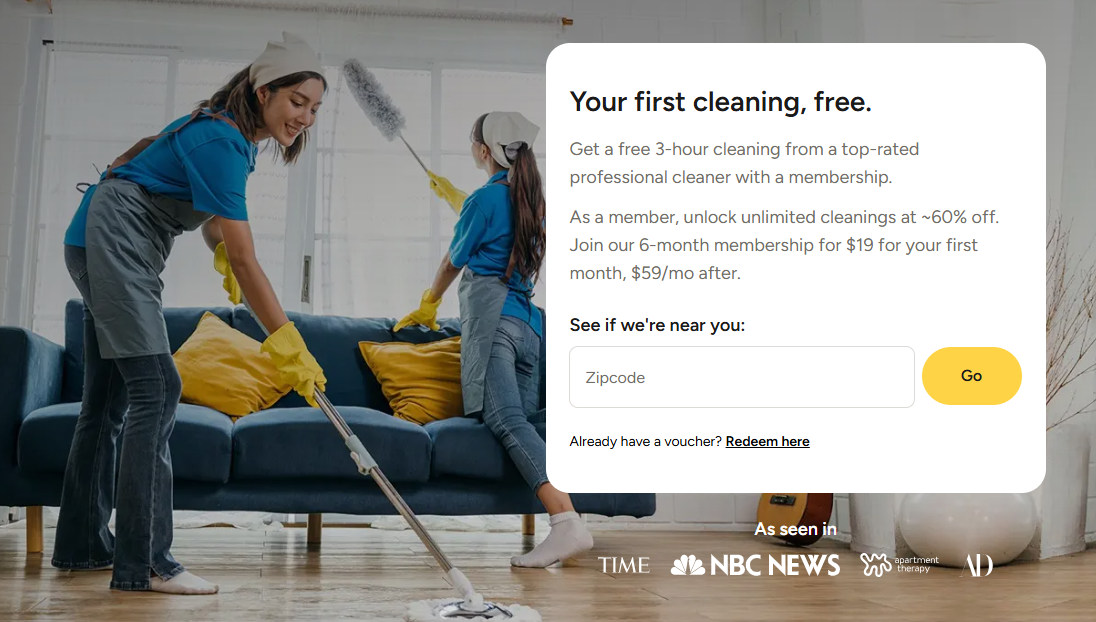
Homeaglow’s ForeverClean membership offers an attractive deal for new customers: pay just $19 for the first month and get a free three-hour cleaning included.
If you need longer cleaning sessions, these will cost more, but they are still heavily discounted. For instance, a four-hour cleaning will cost $19 instead of $100 (81% discount), and a six-hour cleaning will cost $59 rather than $150 (61% discount). Thereafter, you’ll pay the standard hourly fees for cleaning, with ongoing discounts of up to 50% or 60%. Your membership fee doesn’t count as a credit towards actual cleaning costs.
From the second month onwards, the additional membership cost increases to $59/month. However, being a member of Forever Clean continues to provide you with substantial ongoing discounts.
TIDY: Best for a Managed Experience
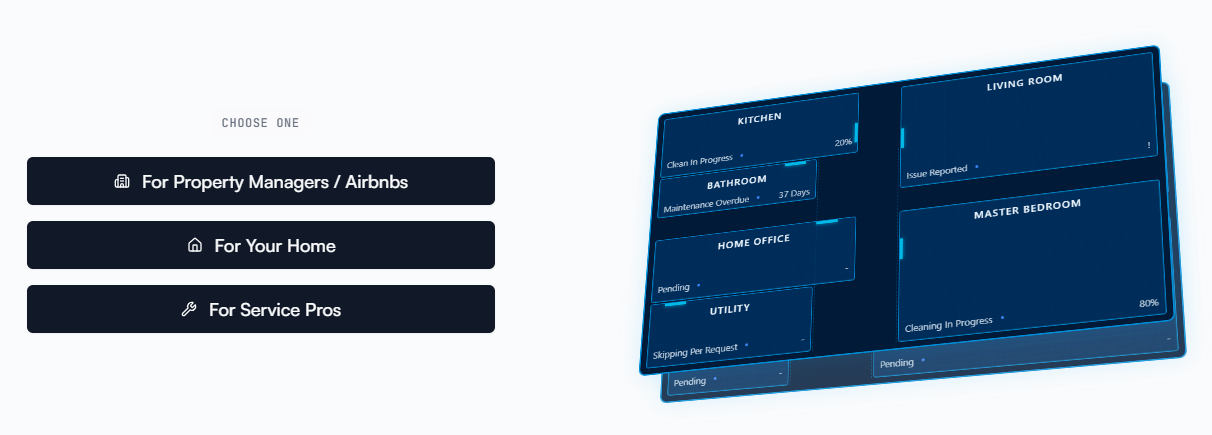
TIDY’s same-pro guarantee is a big benefit for many customers who value a managed cleaning experience. It works particularly well for those wanting assistance with maintenance management and is also beneficial for those who aren’t sure how often they’ll need cleanings.
Their AI-powered platform provides a list of suitable house cleaners from which to choose. Alternatively, the pro-matching option will match you with a cleaner to meet your needs. This is based on the details you provide, including location, home size, and required timeframe for cleaning. Once you’ve signed up, it co-ordinates everything automatically, executing your instructions and handling all the tasks a property manager would normally be in charge of.
Choosing a Cleaner
Deciding which cleaner to use from Homeaglow or TIDY can be confusing. You’re basically making a decision about which stranger you’re going to allow into your home. For this reason, background checks and verification of operators will be paramount to most people.
All Homeaglow cleaners are background-checked and vetted before they are accepted onto the platform. All cleaners must have a valid Social Security Number, and they must be legally allowed to work in the US. They must also pass a criminal background check. Additionally, they are rated by customers in terms of quality of work and reliability, and these reviews are available on the website.
TIDY states that choosing a vetted cleaning pro will take you less than two minutes. However, the platform’s booking features only display basic information about available professionals that meet your needs. When searching for pros, ID verification and background-check information will only appear if you enable “Compliance Requirements” when searching. The same applies to their Pro Search Agent, which is available to match customers with the best available cleaner. It’s up to you to apply the criteria that matter to you, including background checks, certifications, pricing, and so on.
Cleaner Consistency
When a cleaner works well, it’s not unusual for residents needing regular house cleaning to want the same person to return every time. This is not only to make sure consistent cleaning, It’s also because you build up trust with people when they do the job well.
Both Homeaglow and TIDY allow customers to rebook cleaners or change to someone new. The main difference is that TIDY encourages customers to use the same pro cleaner all the time. Unless you decide to change the cleaner, by default, you will get the same person each time.
Homeaglow leaves the decision of who to choose and rebook up to you.
Pricing Models
It’s worth comparing the costs of using Homeaglow and TIDY, but their advertised starting prices don’t tell the whole story. The two pricing models work in fundamentally different ways.
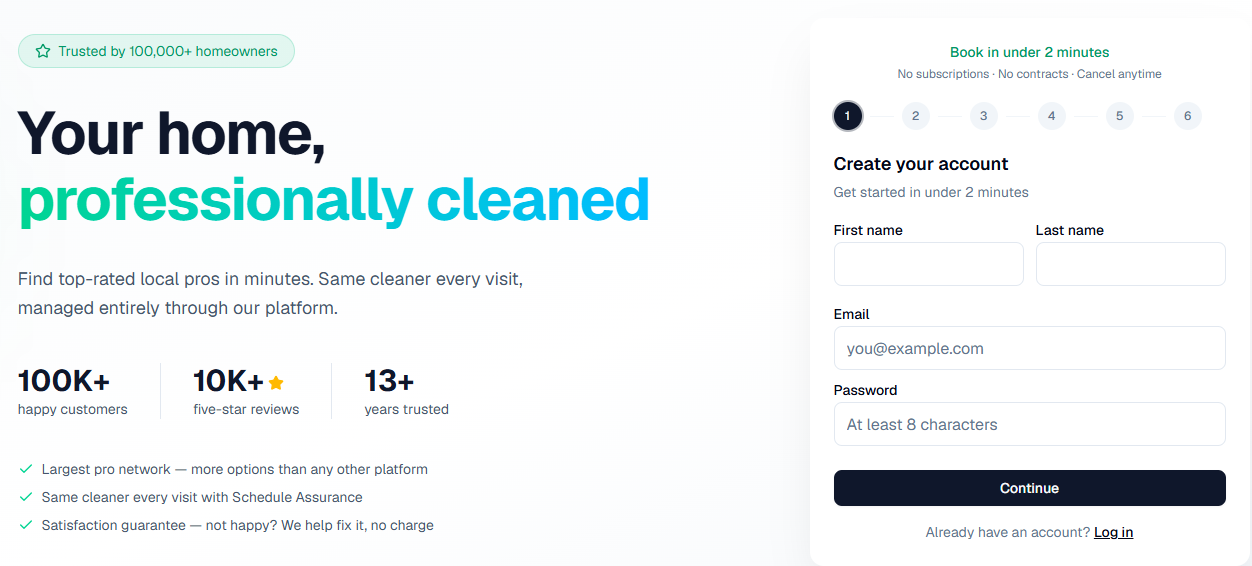
Homeaglow runs on a discounted membership structure, where what you pay depends on your subscription status and how often you book. TIDY runs on a flat, quote-based structure, where the price is tied to your home and job size rather than a membership tier.
If you’re using price as a deciding factor, the real question isn’t which one is cheaper on paper. It’s what you’d realistically pay over time based on how often you’d use the service.
Homeaglow’s Pricing Model Break Down
My assessment is that Homeaglow is the best low-price option. Their average standard hourly rate is $48. But, as mentioned above, if you opt for ForeverClean membership, you get a first-month reduced membership fee of $19. They also provide a two or three-hour cleaning when you sign up.
The membership fee increases to $59/month for the next five months, and you’ll also have to pay for cleaning, which is billed at an hourly rate. However, these fees are discounted by at least 50% on an ongoing basis for members. Unless you cancel, membership will auto-renew for another six months. If you cancel before paying for your first six months, there will be an early termination fee based on the initial discount for your first cleaning. Typically, it’s between $150 and $200.
You aren’t forced to join ForeverClean. But if you opt not to become a member, you’ll be charged according to the standard price structure. No discounts (see my pricing example below).
TIDY’s Pricing Model Break Down
TIDY doesn’t charge a subscription or membership fee, and it doesn’t require contracts. It does offer built-in discounts for recurring bookings (its own guidance cites savings of 10–20% per visit for weekly or biweekly plans), though these aren’t tied to a paid membership.
They advertise starting prices at $55 for smaller spaces. The exact price you’ll be charged is dependent on the size of your home and your personal requirements, as well as the time required to do the cleaning. There’s no price list or table to work out costs. They do, though, say that a same-day cleaning for a one- or two-bedroom apartment will usually take one to two hours. And the starting cost for this will be about $55-$150. You’ll only get to see a more exact price when you book but they do state on their website that a standard cleaning is between $100-$300 dollars with the national average being $180.
A Realistic Example
Say you book one 3-hour cleaning a month. With Homeaglow, after your discounted first month, you’d pay the $59 membership fee plus the member rate ($18-28/hr) for a 3-hour clean, roughly $54 to $84. That puts your total monthly cost somewhere around $113 to $143. With TIDY, you’d pay the quoted price for that job directly, with the national average for a standard cleaning sitting around $180, and no separate monthly fee on top.
Assessment of Time Needed for Cleaning
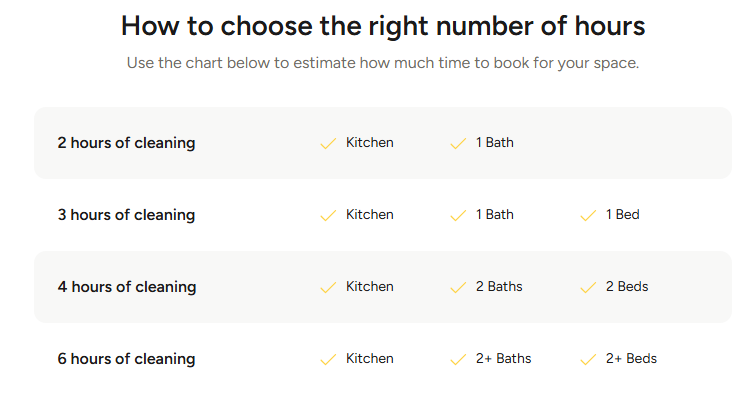
Homeaglow has a chart that customers can use to estimate how much time cleaning tasks are likely to take. Of course, there are many parameters to take into account, but it’s a good starting point:
- 2 hours will enable cleaning of a kitchen and bathroom
- 3 hours for a kitchen, bathroom, and bedroom
- 4 hours for a kitchen, two bathrooms, and two bedrooms
- 6 hours for a kitchen and more than two bathrooms and bedrooms
TIDY doesn’t suggest how long it will take for cleaning tasks. However, they do state that a same-day cleaning for a one- to two-bedroom apartment should take one to two hours (I’m not sure how realistic this is as it sounds quite quick).
Booking and Minimum Cleaning Fees
Homeaglow and TIDY both charge a booking fee that is directly related to minimum cleaning times.
Homeaglow’s booking fee starts at 5% and is calculated as a percentage of the total cleaning fee. They have a minimum two-hour booking for all cleaning sessions, whether you’re a ForeverClean member or not. This means the booking fee will be at least 5% of two hours cleaning.
TIDY for Homes doesn’t charge a separate booking fee at checkout. That’s not to say the service is free to run, TIDY has to make money somehow, but whatever their cut is, it’s already folded into the quoted price you see before you book. The number you’re quoted is the number you pay, with no fee revealed later.
TIDY also builds in a small incentive around how you pay. On a sample booking, I saw a 2.5-hour cleaning quoted at $125 if paid upfront (fully refundable up to 24 hours before the appointment), versus $138 if paid after the job, a $13 difference in your favor for prepaying. Either way, that quoted number is the full price.
Extra Costs
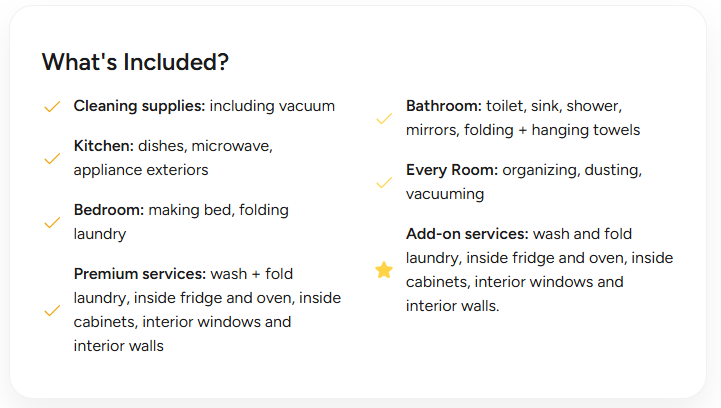
Extra costs include add-on services that aren’t included in a standard cleaning.
Homeaglow advises adding a half hour per extra service when estimating cost for multiple add-ons. This includes laundry, interior windows, ovens, refrigerators, cabinets, and baseboards.
Other extra costs you might be charged by Homeaglow include a premium cleaning fee if you choose:
- a premium cleaner when booking, or
- a priority fee if you book or reschedule
TIDY has several add-on extras that will increase the basic costs of house cleaning. Add-on services like inside-fridge cleaning, inside-oven cleaning, window washing, and laundry are usually priced separately, typically $15 to $60 each. For more specialized jobs (like handyman work versus standard cleaning) you can expect higher fees.
Day-to-Day Customer Experience

Having decided to employ a house cleaner, it’s important to assess just how much you, the customer, will have to do. It’s not just the booking process. The customer experience also relates to communication with cleaners, setting parameters for cleaning, and checking whether instructions have been followed and the target reached.
We’ve established that Homeaglow provides suitable vetted options from which you can choose. You then browse cleaners, choose someone, set a timeframe, convey your requirements, and then decide whether to rebook them. That gives you control, which also means you have to make decisions and communicate your needs and expectations with your cleaner regularly.
While they outline what standard cleaning tasks cover, it’s up to customers to make sure cleaners are aware of any specific needs or priorities.
For many people, communication is key. So, this would be an advantage, also because they can see what’s happening in their homes.
TIDY removes the stress of cleaning management. You select from the pros suggested by its AI tools or allow the platform to match a cleaner based on your requirements. Once you’ve booked, much of the communication and scheduling is automated. If you want to use the same pro, TIDY’s system is designed around that continuity.
They also provide custom AI-generated checklists for cleaners to follow when they visit. Another perk is the photo verification they produce with before-and-after photos. This helps you make sure every cleaning meets your required standards.
This is a great approach for property managers and possibly also for people working long hours away from home.
Which Service to Choose: Homeaglow or TIDY
It’s clear to me that these two cleaning platforms will appeal to different types of customers. Ultimately, it depends on what you are looking for.
Price alone isn’t going to be the deciding factor. The $19 Homeaglow introductory offer versus TIDY’s $55 starting point makes Homeaglow look like the obvious winner at first glance. But Homeaglow’s membership costs change over time, while TIDY has its own fees and minimums and $55 is well below what they quote as their national average. You will need to decide which pricing model works better for the way you use a cleaning service.
Homeaglow is likely to suit those who want discounted, regular cleanings and are happy to let a membership fee work in their favor over time, as well as those who want to choose the person coming into their home.
TIDY will be more appealing to those who don’t want regular cleanings, prefer more spaced-out bookings, or would rather specify what they need and let the platform handle more of the process.
The post Homeaglow vs TIDY: Which Cleaning Service Is Better? appeared first on Penny Pinchin' Mom.