2 months ago
41
2 months ago
41
The post Credit Karma Alternatives for Personal Loans: What Else Is Actually Out There appeared first on Penny Pinchin' Mom.
If you are here, chances are you are either looking for a personal loan or wondering if there’s a better option out there for you. In the US, more than one third of Americans have personal loans and with so many different lending options, it can be so overwhelming to know where to start.
If you’re like me, you’ve probably found yourself using a comparison site to try and find the best deal on a loan. These types of sites are useful because they consolidate and unify all your options into one place, helping you better identify what is available in the market for your specific needs and conditions. One of the most popular sites is Credit Karma, but there are plenty of other options that might actually work better for you.
My goal is to break down where Credit Karma shines, where a different site could serve you better, and what the pros and cons are for each. With these Credit Karma Alternatives for Personal Loans, hopefully you walk away feeling more confident about where to go for your loan.
Where Credit Karma Shines

Integration with your credit data & history
By far, Credit Karma’s strongest advantage is the ability to run a soft credit pull and get you prequalified offers from lenders in their network within minutes. This allows you to get the most accurate layout of the rates and conditions you can get for your specific credit history, and its integration with your credit makes it a great option for a lot of people. Once it is connected to your credit, it can be very helpful, as it will constantly monitor your credit score. So if your score dropped 25 points because a card balance spiked (we’ve all been there), Credit Karma will update your options accordingly. This feature is huge and makes the rate shopping experience very personal to your situation.
They show you Approval Odds
Because Credit Karma already has your credit profile from the monitoring side, they can estimate how likely you are to get approved for a given offer. This is pretty insightful, especially because there’s no use in considering an option if your approval is unlikely. In contrast, most comparison sites can’t do that without asking you to enter everything from scratch, as they don’t maintain your information on a consistent basis.
One thing to keep in mind is that Credit Karma states plainly that Approval Odds are not a guarantee of approval, and that’s an important distinction. Prequalified and approved are two different things. Approval Odds are great for narrowing down where to spend your one hard pull, but the lender still makes the final call once they run full underwriting on your income and debt-to-income ratio.
They publish their methodology
Credit Karma’s editors evaluate lenders across three categories: affordability (rates, origination fees, rate discounts), customer-friendly features (loan amount ranges, term flexibility), and transparency. Having a strong understanding of a comparison site’s rating methodology can help you hone in on the site that tracks the features most important to you. For example, if you care less about UI experience and more about affordability, it might be worth using one comparison site over another that weights affordability higher in its rating.
It’s free to use
This site is completely free to use and doesn’t hide behind a paywall. Like most comparison sites, they make money when you click through and take a loan from one of their partners. This means the lenders you see are the lenders they work with, and not the whole market, which is why you should take a look at multiple comparison sites to ensure you get a full picture of what is available. It might take an extra half hour, but it can make a massive financial difference. For example, on a $35K loan over five years, the gap between a 12.5% APR and a 13.5% APR is roughly $1,075. On the monthly payment that looks like eighteen dollars, which seems like nothing and is exactly why people don’t bother comparing. But eighteen dollars a month for sixty months is over a thousand dollars. Over $1K for an extra half hour of work is more than doctors make!
The Criteria I Used to Compare Everything Else

Before listing alternatives, here’s what I cared about when comparing options. These are the five things that separate a useful loan shopping tool from a lead generation form.
1. How many lenders you see. To me, the more options, the better. Being able to compare against multiple lenders gives you a broader fishing net when trying to find the best deal.
2. Whether it’s a real soft pull. Every reputable platform prequalifies with a soft inquiry. If a site wants a hard pull just to show you a rate, close the tab.
3. What happens to your phone number and personal information. Unfortunately, this is one of those things you learn the hard way. Let me paint the picture: you find yourself on one of the comparison sites that advertise what seems to be a great deal. It asks you for your information, and the moment you click submit, you are getting a call to your phone. You answer and it is one lender. While you are still on the call, you are getting two more. This is such a big red flag to me, and something I can’t stand. You want to make sure the site keeps you in a closed comparison environment until you choose to click through to a specific lender.
4. How transparent the platform is about how they make money. Every free comparison site is ad-supported. The question is whether they tell you clearly and whether they explain how compensation affects what you see.
5. How quickly you can see options. Some comparison sites show you right away what options there are, and have slicers at the top you can use. Others force you to sign in and provide a bunch of personal information before you even see the options. For me, when I’m shopping around, the barrier to entry has to be low. If it’s asking me for a bunch of information within a few clicks on their site, I typically move on to another one. Credit Karma, specifically, forces you to sign in and provide credit information. While this might be helpful to get more tailored options, I find it to be kind of annoying when you are just looking for a quick scope of what is available in the marketplace.
Credit Karma Alternatives
NerdWallet

NerdWallet is the closest thing to a direct alternative if what you liked about Credit Karma was the combination of credit score access and loan shopping. They also give you a free TransUnion credit score, and they have a personal loan marketplace with soft-pull prequalification. The downside, similar to Credit Karma, is that you must sign in and provide personal information before you see personal loan options.
Where they pull ahead is the editorial depth. NerdWallet publishes granular rating methodologies for personal loans, scoring lenders across multiple categories and subcategories, and they write full individual reviews of each lender. If you want to understand why Upstart might work for a thin credit file and why LightStream won’t, their content breaks it down.
They also have a calculator suite that’s hard to beat. Loan payment calculators, debt payoff timelines, amortization schedules. I personally use these calculators more than anything, and they’re especially helpful when trying to compare different loan options, like whether a 3-year or 5-year term makes more sense.
The tradeoff is NerdWallet’s experience is article-first. You’re reading a curated “best personal loans” list written by an editor, instead of scanning a filterable comparison table. For me, I prefer the latter.
BestMoney
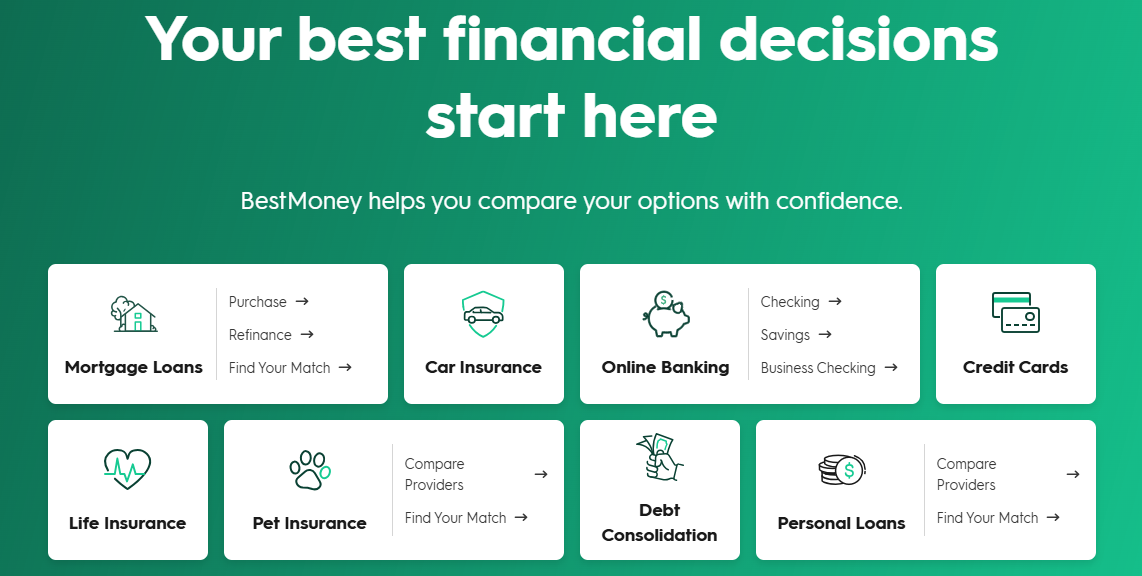
To me, BestMoney’s biggest advantages are how quickly you are able to see your options, the user interface and ease of use, and the ability to customize to your situation without signing in. As soon as you land on the personal loans page, at the time of writing this article, you are presented with a variety of loan options. At the top, you have the ability to slice by loan purpose, loan amount, your annual income, and your credit score range, and have the results filter based on your specific needs and situation. Then it breaks down APR ranges, term lengths, minimum credit score requirements, and an editorial score, all in one view. It takes about 30 seconds to get a read on where rates cluster for someone in your situation, versus scrolling through a long article to find the three lenders worth considering, or having to create a new account and/or sign in and fill out a bunch of information like NerdWallet/Credit Karma.
BestMoney states that advertising compensation can influence placement and may affect their scores, and that not every provider in the market is listed. Most platforms say compensation affects placement but not ratings. BestMoney acknowledges it can touch both. I appreciate the transparency and would rather have this than a platform that hides the truth.
They also cover categories Credit Karma doesn’t really get into: debt relief programs, tax relief, business finance. If your personal loan search is actually a “how do I get out from under this debt” search, having those adjacent options on the same platform is genuinely useful.
The limitation: individual lender reviews on BestMoney are shorter than NerdWallet’s. If you want a 2,000-word breakdown of a single lender’s edge cases, you’ll want to go elsewhere for that step. Additionally, BestMoney is not a credit monitoring tool and won’t give you a credit score or track your report. BestMoney is built for comparison, not necessarily deep-dive research.
So while it’s not fully integrated with your credit report, if your goal is to easily identify the rates being offered for your specific situation without needing to sign in and provide personal information, this is the clear winner.
LendingTree
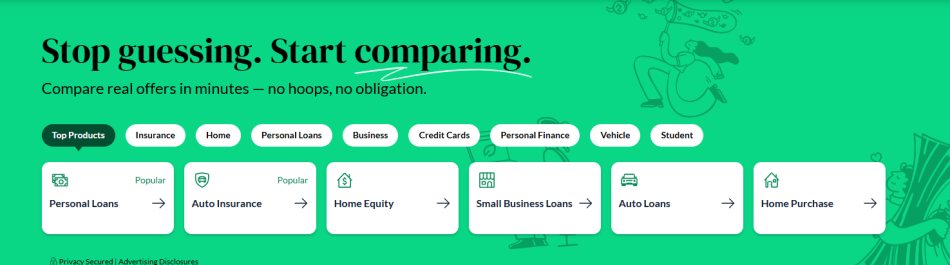
One of the oldest loan matching networks, being founded in 1996, LendingTree works with a network of over 300 lenders across all their product lines. In terms of pure breadth, they’re hard to beat. All you need to do is fill out one form and you can get back multiple prequalified offers within minutes.
Here’s the thing you need to know before using it and one of the most common complaints in their reviews: LendingTree’s model involves passing your information to lenders in their network, and those lenders contact you directly. Users consistently report a high volume of calls, texts, and emails after submitting, and you can see that in their rating of 1.1/5 with over 1.5K reviews on consumer affairs. In fairness, on Trustpilot they sit at 4.5 out of 5 across nearly 17,000 reviews, so plenty of people clearly have a fine experience. But when people are unhappy, it is almost always about the phone calls. To me, this is all it takes to make me never want to use a company again. While the calls are from legitimate lenders, getting more than a few can result in a negative customer experience and that is clearly visible in the reviews.
If you want maximum lender exposure and you don’t mind the follow-up, LendingTree gives you the widest net. Otherwise, there are better options out there.
How These Stack Up
Here’s the summary view:
| Platform | Best For | Contact Info Risk | Credit Score Tool |
| Credit Karma | Score + loans in one place based on your credit score | Low | Yes (VantageScore) |
| BestMoney | Fast side-by-side comparison. No sign-in to view rates. | Low | No |
| NerdWallet | Deep reviews, a suite of calculators | Low | Yes (TransUnion) |
| LendingTree | Widest lender network | High | Yes |
Where to go from here

If you are already using Credit Karma, I’d keep using it if you like it. It’s free, the credit monitoring is useful, and the Approval Odds feature gives you a reasonable starting read on where you stand.
Just don’t stop there. Run your comparison through a second platform so you can see whether the rates you’re being shown are actually competitive, because as stated previously in the article, you only see the lenders that partner with the specific comparison site, so it’s worth checking multiple to ensure you have the best option for your situation.
Personally, BestMoney is a no-brainer as a second option, as the barrier to entry is super low, you don’t even need to sign in, and within 30 seconds, you can see a side-by-side comparison of a variety of different lenders. From there you can pre-qualify with the lender of your choice and move forward knowing you considered multiple options.
The post Credit Karma Alternatives for Personal Loans: What Else Is Actually Out There appeared first on Penny Pinchin' Mom.